
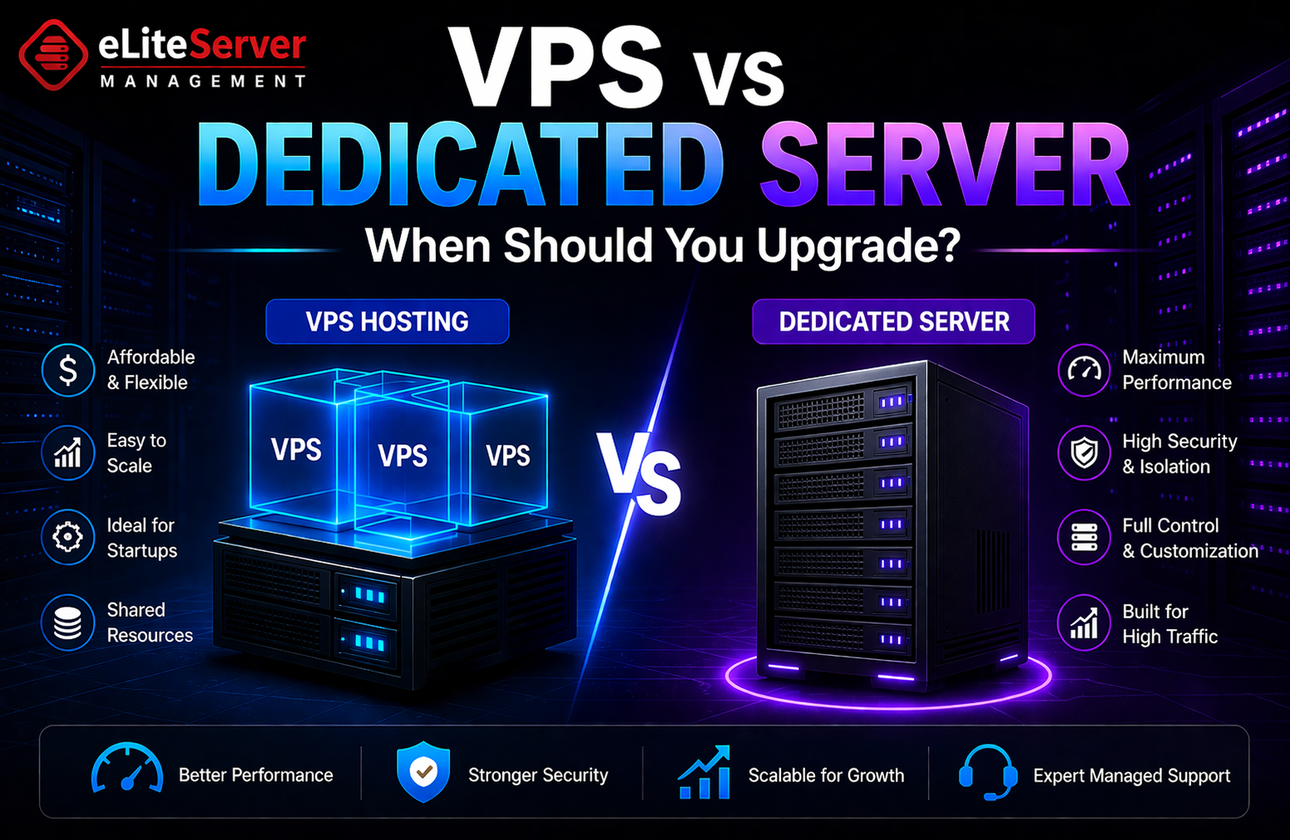
VPS vs Dedicated Server: When Should You Upgrade?
Choosing between a VPS and a dedicated server isn’t just about cost—it’s about performance, reliability, scalability, and long-term growth.
Many businesses start with VPS hosting because it’s flexible and cost-efficient. But at some point, performance bottlenecks, security concerns, or scaling limitations start to appear. That’s when the question becomes critical:
Is it time to upgrade to a dedicated server?
This guide breaks down real-world scenarios to help you make that decision with confidence.
Understanding the Core Difference
Before deciding when to upgrade, it’s important to understand what you’re actually moving from and to.
What is VPS Hosting?
A VPS (Virtual Private Server) is a virtualized environment within a physical server. You get dedicated resources (CPU, RAM, storage), but you still share the underlying hardware.
Best suited for:
- Growing websites
- SaaS startups
- Medium-traffic applications
- Development environments
Explore optimized VPS solutions here:
👉 https://eliteservermanagement.com/ssd-vps-server.php
What is a Dedicated Server?
A dedicated server gives you full control over an entire physical machine. No shared resources, no noisy neighbors, and complete customization.
Best suited for:
- High-traffic platforms
- Resource-heavy applications
- Enterprise workloads
- Performance-critical systems
Learn more about dedicated environments:
👉 https://eliteservermanagement.com/managed-dedicated-server.php
When VPS Starts Becoming a Limitation
VPS hosting works well—until it doesn’t. Here are the most common signals that you’re outgrowing it.
1. Performance Bottlenecks Under Load
If your website slows down during traffic spikes, your VPS may not be able to handle peak demand.
Real-world example:
An eCommerce store running flash sales sees page load times jump from 1.5s to 5s during peak traffic. Conversions drop instantly.
Why does this happen:
- Limited CPU allocation
- Shared I/O performance
- Resource contention
Dedicated server advantage:
- Consistent performance under load
- Full hardware utilization
- No neighbor interference
2. Increasing Resource Demands
Applications evolve. Databases grow. Background jobs increase.
If you're constantly upgrading your VPS plan, you're likely hitting its ceiling.
Warning signs:
- Frequent CPU spikes
- Memory exhaustion errors
- Disk I/O throttling
At this stage, moving to a managed dedicated server provides predictable performance and scalability.
3. Security and Compliance Requirements
For many businesses, especially in fintech, healthcare, or SaaS, security isn’t optional.
VPS limitations:
- Shared hypervisor layer
- Higher exposure risk
- Limited control over hardware-level security
Dedicated server benefits:
- Full isolation
- Custom firewall rules
- Advanced hardening options
Strengthen your infrastructure here:
👉 https://eliteservermanagement.com/server-security-services.php
👉 https://eliteservermanagement.com/cpanel-server-hardening.php
4. Custom Infrastructure Needs
Some applications require:
- Custom kernel modules
- Specialized hardware configurations
- Advanced networking setups
These are difficult or impossible in VPS environments.
Dedicated servers give you:
- Root-level control
- Hardware customization
- Advanced networking flexibility
5. Scaling Becomes Inefficient
Vertical scaling on VPS (adding more CPU/RAM) has limits—and costs rise quickly.
At a certain point, you’re paying close to dedicated server pricing… without getting full performance.
That’s where upgrading becomes a smarter investment.
When You Should Upgrade to a Dedicated Server
Let’s make it practical. You should strongly consider upgrading if:
✔ You’re Running High-Traffic Websites
- 100K+ monthly visitors
- High concurrency applications
- Real-time services
✔ You Handle Sensitive Data
- Customer payment data
- Private user information
- Compliance-heavy workloads
✔ You Need Consistent Performance
- SaaS platforms
- APIs
- Gaming servers
- Streaming services
✔ You’re Experiencing Downtime or Instability
Frequent crashes or slowdowns are a clear signal that your infrastructure is underpowered.
✔ You Want Long-Term Scalability
Dedicated servers allow better planning for growth without constant migrations.
Cost vs Value: The Real Perspective
Many businesses hesitate due to cost, but this is often a short-term view.
VPS Cost:
Lower upfront, but:
- Performance limitations
- Scaling inefficiencies
- Potential revenue loss from slow performance
Dedicated Server Cost:
Higher upfront, but:
- Stable performance
- Better ROI at scale
- Improved user experience
- Stronger security posture
The Role of Server Management
Upgrading infrastructure is only part of the equation.
Without proper management, even a dedicated server can underperform.
That’s why businesses rely on professional
👉 https://eliteservermanagement.com/managed-server-services.php
What managed services include:
- Performance optimization
- Proactive monitoring
- Security hardening
- Backup configuration
- Issue resolution
Migration: What to Expect
Moving from VPS to a dedicated server doesn’t have to be risky.
With proper planning, it can be seamless.
Professional migration services ensure:
- Zero or minimal downtime
- Data integrity
- Optimized configurations
Start your migration here:
👉 https://eliteservermanagement.com/server-migration-services.php
Don’t Forget Monitoring & Backups
Upgrading infrastructure without visibility is a mistake.
Server Monitoring
Real-time monitoring ensures:
- Early issue detection
- Performance tracking
- Uptime reliability
👉 https://eliteservermanagement.com/cpanel-server-monitoring.php
Backup Strategy
Data protection is critical at any scale.
👉 https://eliteservermanagement.com/backup-services.php
Final Decision Framework
If you're still unsure, use this quick checklist:
| Situation | Recommendation |
|---|---|
| Small to medium traffic | Stay on VPS |
| Growing traffic spikes | Consider upgrade |
| High-performance needs | Dedicated server |
| Security-critical apps | Dedicated server |
| Scaling inefficiencies | Upgrade now |
The Bottom Line
A VPS is a great starting point—but it’s not designed for long-term, high-performance workloads.
Upgrading to a dedicated server isn’t just about power. It’s about:
- Reliability
- Security
- Scalability
- Business continuity
If your infrastructure is limiting your growth, it’s time to move forward.
7. CTA Section (Soft Conversion)
Ready to Upgrade Without Risk?
If you're noticing performance issues or planning for growth, our team can help you transition smoothly—without downtime or guesswork.
✔ Infrastructure assessment
✔ Seamless migration
✔ Fully managed dedicated servers
✔ 24/7 expert support
👉 Explore your upgrade path today:
https://eliteservermanagement.com/managed-dedicated-server.php