
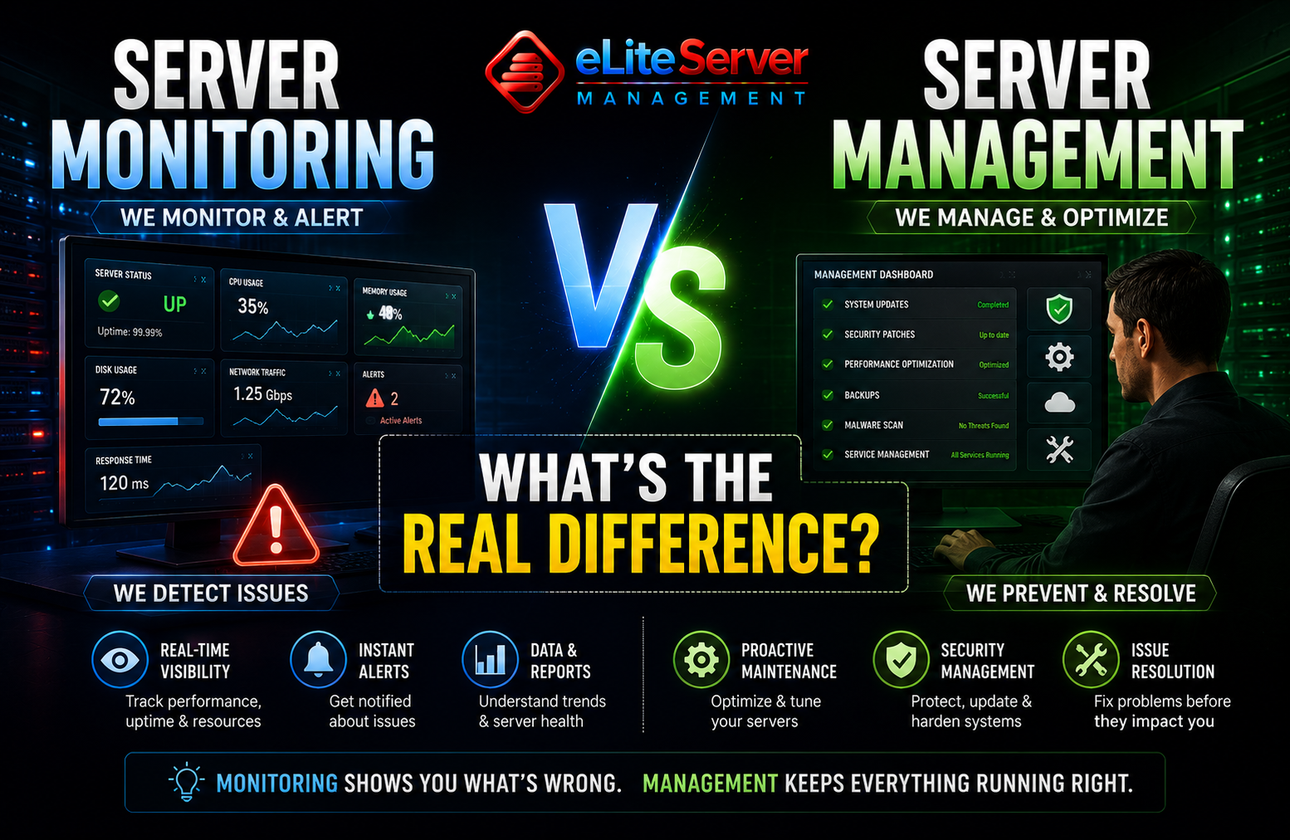
Server Monitoring vs Server Management: What’s the Real Difference?
Introduction
Many businesses assume server monitoring and server management are the same thing.
They are not.
While both are important for infrastructure stability, they solve very different problems.
Understanding the difference is critical because:
- Monitoring alone does not prevent issues
- Management alone without visibility is risky
Production infrastructure usually requires BOTH.
Let’s break down the real differences.
What Is Server Monitoring?
Server monitoring focuses on:
✅ visibility
✅ alerts
✅ uptime tracking
✅ performance observation
Monitoring tools watch the infrastructure for:
- CPU spikes
- RAM usage
- disk failures
- downtime
- unusual activity
Monitoring tells you:
👉 “Something is wrong.”
What Monitoring DOES NOT Do
Monitoring alone usually does NOT:
❌ Fix issues
❌ Optimize servers
❌ Secure infrastructure
❌ Update software
❌ Harden configurations
This is where many businesses misunderstand infrastructure operations.
What Is Server Management?
Server management is proactive operational maintenance.
This includes:
✅ optimization
✅ security hardening
✅ patching
✅ troubleshooting
✅ performance tuning
✅ infrastructure administration
Management actively works to:
👉 prevent problems before they happen.
Monitoring vs Management — Simple Example
Monitoring:
“Your server CPU usage is at 98%.”
Management:
“Your server was optimized, load-balanced, secured, and tuned to prevent overload.”
That’s the difference.
Why Businesses Need Both
Production environments require:
- visibility
- proactive maintenance
- security oversight
- operational stability
Monitoring without management leads to:
❌ alert fatigue
❌ unresolved issues
❌ recurring downtime
Management without monitoring reduces infrastructure visibility.
Together, they create stable operations.
What Professional Monitoring Includes
Professional monitoring often tracks:
- uptime
- services
- disk health
- traffic anomalies
- database performance
- resource usage
👉 Learn more:
Server Monitoring Services: https://eliteservermanagement.com/cpanel-server-monitoring.php
What Professional Server Management Includes
Managed infrastructure services often include:
- Linux administration
- optimization
- patch management
- malware cleanup
- security hardening
- troubleshooting
👉 Explore:
Managed Server Services: https://eliteservermanagement.com/managed-server-services.php
Security Monitoring Matters Too
Modern infrastructure threats require:
- continuous monitoring
- intrusion detection
- suspicious activity alerts
👉 Learn more:
Server Security Services: https://eliteservermanagement.com/server-security-services.php
The Biggest Mistake Businesses Make
One of the most common mistakes:
❌ installing monitoring tools and assuming infrastructure is “managed.”
Monitoring tools are useful — but they are NOT a replacement for experienced infrastructure administration.
Which Businesses Need Both?
Usually:
✅ ecommerce businesses
✅ SaaS applications
✅ hosting providers
✅ agencies
✅ production workloads
✅ high-traffic websites
need both monitoring and proactive management.
Final Thoughts
Monitoring helps businesses SEE infrastructure problems.
Management helps businesses PREVENT and SOLVE them.
The most stable environments combine:
✅ visibility
✅ proactive optimization
✅ continuous security
✅ experienced administration
Reliable infrastructure is not built reactively.
It’s maintained proactively.
Need Proactive Infrastructure Support?
Whether you need monitoring, server management, optimization, or security hardening, Elite Server Management can help keep production infrastructure stable and secure.
👉 Contact Our Team: https://eliteservermanagement.com/contact.php