
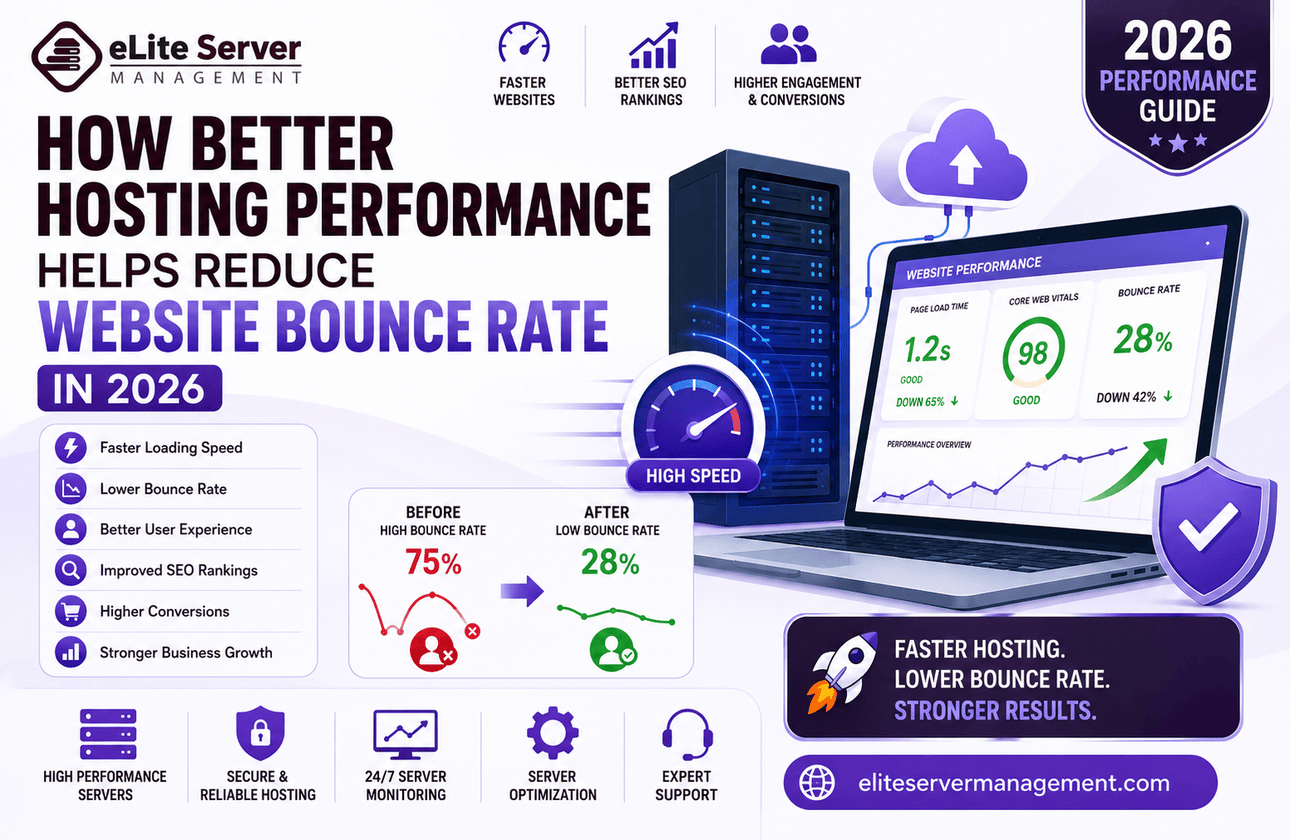
How Better Hosting Performance Helps Reduce Website Bounce Rate in 2026
Introduction
Imagine spending thousands of dollars on SEO, paid advertising, and content marketing only to have visitors leave your website within a few seconds. Unfortunately, this is a common problem for businesses with slow or poorly optimized hosting infrastructure.
Website bounce rate is one of the most important indicators of user experience. A high bounce rate often signals that visitors are not finding what they need quickly enough or that the website is too slow to use. Search engines such as Google increasingly prioritize user experience, meaning that poor website performance can negatively impact both rankings and conversions.
While many website owners focus on optimizing images, installing caching plugins, or improving their content, they often overlook one of the biggest factors affecting bounce rate: hosting performance.
Whether you're running an eCommerce store, a corporate website, a SaaS platform, or a hosting business, investing in better hosting infrastructure can significantly improve website speed, reduce bounce rates, and increase customer satisfaction.
In this guide, we'll explain how hosting performance directly affects user behavior, why faster servers matter for SEO, and what you can do to keep visitors engaged in 2026.
What Is Website Bounce Rate?
Bounce rate refers to the percentage of visitors who leave your website after viewing only one page without taking any further action.
For example:
- A visitor lands on your homepage.
- The page loads slowly.
- They become impatient and leave without clicking another page.
This counts as a bounce.
A high bounce rate may indicate:
- Slow page loading
- Poor user experience
- Confusing navigation
- Unresponsive design
- Irrelevant content
- Weak server performance
Although bounce rate alone is not a direct Google ranking factor, it often reflects user satisfaction, which is closely related to SEO performance.
Why Hosting Performance Matters
Many people assume website speed depends only on website design or plugins.
In reality, your hosting environment determines how quickly your website can deliver content.
A hosting server is responsible for:
- Processing requests
- Running PHP applications
- Querying databases
- Delivering website files
- Serving images
- Managing SSL encryption
- Handling concurrent visitors
If the server struggles with these tasks, your website becomes slower regardless of how well it is optimized.
Businesses using outdated shared hosting often experience slower response times compared to websites hosted on optimized VPS or dedicated servers.
If your website experiences performance issues, consider upgrading to a Managed Dedicated Server:
https://eliteservermanagement.com/managed-dedicated-server.php
How Slow Hosting Increases Bounce Rate
Visitors expect websites to load almost instantly.
Research consistently shows that even a one-second delay can reduce user satisfaction and conversions.
Slow hosting leads to:
- Delayed page rendering
- Longer database queries
- Slow image delivery
- Increased waiting times
- Session timeouts
- Server errors during peak traffic
As a result, visitors leave before engaging with your content.
This not only increases bounce rates but can also reduce sales, lead generation, and customer trust.
The Relationship Between Website Speed and SEO
Google has made website performance an essential part of its ranking algorithms through Core Web Vitals.
These metrics measure how users experience your website in real-world conditions.
Important performance indicators include:
Largest Contentful Paint (LCP)
Measures how quickly the main content appears.
Interaction to Next Paint (INP)
Measures responsiveness to user interactions.
Cumulative Layout Shift (CLS)
Measures visual stability while pages load.
A faster hosting environment improves these metrics, helping your website provide a smoother browsing experience.
Benefits of Better Hosting Performance
1. Faster Page Loading
Modern hosting infrastructure using NVMe storage, optimized web servers, and high-performance CPUs can dramatically reduce loading times.
Visitors are more likely to stay when pages load quickly.
2. Improved User Experience
Fast websites encourage visitors to:
- Read more articles
- Browse products
- Submit contact forms
- Complete purchases
- Return in the future
A positive experience often translates into higher engagement and lower bounce rates.
3. Higher Search Engine Rankings
Search engines reward websites that provide excellent user experiences.
Fast websites generally achieve:
- Better crawl efficiency
- Improved Core Web Vitals
- Higher user engagement
- Longer session durations
All of these contribute to stronger long-term SEO performance.
4. Better Conversion Rates
Whether your goal is selling products or generating leads, website speed directly impacts conversions.
Visitors are far more likely to complete an action when your website feels responsive.
Hosting Features That Improve Performance
Choosing the right hosting environment is one of the most effective ways to improve website speed.
Look for features such as:
NVMe Storage
NVMe drives deliver significantly faster read and write speeds than traditional SSDs, reducing database query times and improving page load performance.
Learn more about our NVMe Dedicated Servers:
https://eliteservermanagement.com/nvme-dedicated-server.php
Dedicated Resources
Unlike shared hosting, dedicated servers provide exclusive access to CPU, RAM, and storage.
This eliminates resource contention and ensures consistent performance even during traffic spikes.
Explore our Dedicated Server Solutions:
https://eliteservermanagement.com/managed-dedicated-server.php
SSD VPS Hosting
For growing websites, SSD VPS hosting offers an excellent balance between affordability and performance.
Benefits include:
- Faster disk access
- Dedicated resources
- Better scalability
- Improved website responsiveness
View our SSD VPS Servers:
https://eliteservermanagement.com/ssd-vps-server.php
Server Optimization Makes a Difference
Even powerful hardware requires proper optimization.
Professional server optimization includes:
- Apache tuning
- LiteSpeed optimization
- Nginx configuration
- PHP-FPM tuning
- MySQL optimization
- Redis and Memcached integration
- OPcache configuration
- Compression and caching
Proper optimization reduces response times while improving overall server efficiency.
Importance of cPanel Server Management
Many business websites run on cPanel.
Without proper administration, servers may suffer from:
- High CPU usage
- Poor MySQL performance
- Mail delivery issues
- Security vulnerabilities
- Inefficient PHP settings
Professional cPanel Server Management Services ensure your server remains optimized, secure, and reliable.
Learn more:
https://eliteservermanagement.com/cpanel-server-management-services.php
Continuous Monitoring Prevents Performance Problems
Performance optimization is not a one-time task.
Servers require continuous monitoring to detect issues before they impact visitors.
Monitoring typically includes:
- CPU usage
- RAM utilization
- Disk space
- Network activity
- Website availability
- Database performance
- Security alerts
Our 24/7 cPanel Server Monitoring helps identify problems before they become downtime:
https://eliteservermanagement.com/cpanel-server-monitoring.php
Security Also Affects Performance
Compromised websites often become significantly slower.
Malware can:
- Consume CPU resources
- Generate unwanted traffic
- Send spam emails
- Create hidden processes
- Increase server load
Regular security hardening and malware protection help maintain both speed and stability.
Learn about our Server Security Services:
https://eliteservermanagement.com/server-security-services.php
Why Managed Server Services Matter
Many businesses don't have an in-house Linux administration team.
Managed server services provide:
- 24/7 server monitoring
- Security updates
- Performance optimization
- Backup management
- Proactive maintenance
- Emergency support
- Resource optimization
By outsourcing server management, businesses can focus on growth while experienced engineers ensure optimal server performance.
Explore our Managed Server Services:
https://eliteservermanagement.com/managed-server-services.php
Practical Tips to Reduce Website Bounce Rate
Alongside better hosting, follow these best practices:
- Upgrade to high-performance hosting.
- Enable server-side caching.
- Optimize databases regularly.
- Compress images.
- Use a Content Delivery Network (CDN).
- Enable HTTP/2 or HTTP/3.
- Keep PHP and MySQL updated.
- Remove unnecessary plugins and themes.
- Minimize JavaScript and CSS files.
- Monitor website performance continuously.
Small improvements in loading speed can lead to significant gains in user engagement.
Why Choose eLite Server Management?
At eLite Server Management, we help businesses improve website performance through professional hosting solutions and proactive server administration.
Our services include:
- Managed Dedicated Servers
- SSD VPS Hosting
- cPanel Server Management
- 24/7 Server Monitoring
- Linux Server Administration
- Performance Optimization
- Security Hardening
- Backup Solutions
- Malware Cleanup
Whether you operate a single website or a large hosting infrastructure, our team helps ensure your servers remain fast, secure, and highly available.
Visit us:
https://eliteservermanagement.com/
Final Thoughts
Reducing website bounce rate is about more than just creating great content. Visitors expect websites to load quickly, remain responsive, and provide a seamless browsing experience. Your hosting infrastructure plays a crucial role in meeting those expectations.
By investing in faster hosting, optimized server configurations, continuous monitoring, and proactive management, you can improve page speed, enhance user satisfaction, strengthen SEO performance, and increase conversions.
In 2026, businesses that prioritize hosting performance will be better positioned to retain visitors, build trust, and grow online.
👉 Contact Our Team: https://eliteservermanagement.com/contact.php