
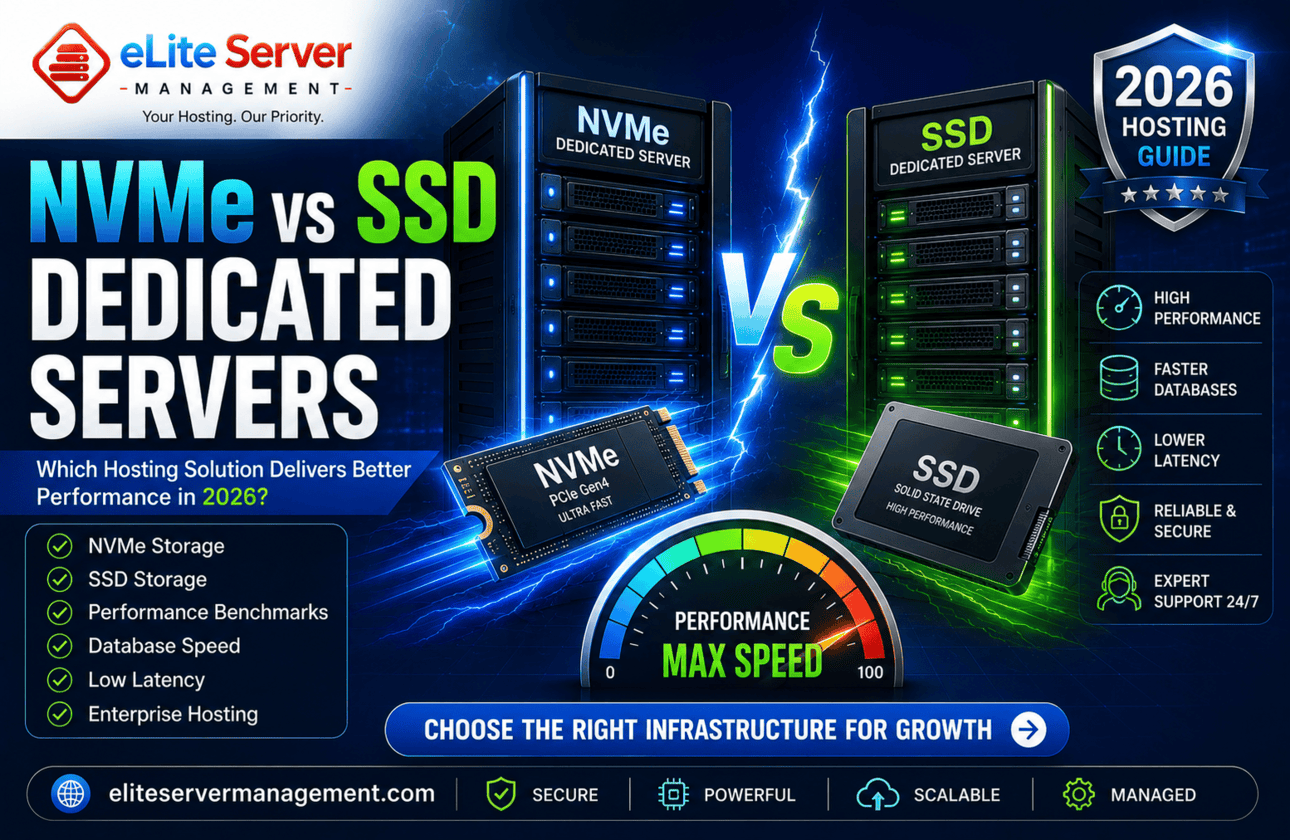
NVMe Dedicated Servers vs SSD Dedicated Servers: Which Hosting Solution Is Right for Your Business in 2026?
Introduction
Choosing the right hosting infrastructure is one of the most important decisions for any growing business. Whether you're running high-traffic websites, eCommerce stores, SaaS applications, game servers, or enterprise workloads, storage performance directly impacts user experience and business outcomes.
Two of the most common hosting options available today are SSD Dedicated Servers and NVMe Dedicated Servers. While both technologies offer significant improvements over traditional HDD-based servers, there are major differences in performance, scalability, latency, and workload handling.
In this guide, we'll compare NVMe and SSD dedicated servers, explore their advantages and limitations, and help you determine which solution best fits your business requirements in 2026.
Understanding SSD Dedicated Servers
SSD (Solid State Drive) servers use flash-based storage instead of mechanical hard drives.
Compared to traditional HDD storage, SSDs provide:
Faster data access
Lower latency
Improved reliability
Better website loading speeds
Reduced hardware failures
SSD dedicated servers remain a popular choice for:
Business websites
Corporate applications
Shared hosting environments
Medium-sized databases
CRM systems
Development environments
SSD storage dramatically improves server responsiveness and overall application performance.
What Are NVMe Dedicated Servers?
NVMe (Non-Volatile Memory Express) is a storage protocol specifically designed for modern flash storage devices.
Unlike traditional SATA SSDs, NVMe drives communicate directly with the CPU through PCIe lanes, significantly reducing storage bottlenecks.
Benefits include:
Ultra-low latency
Faster data processing
Higher IOPS performance
Better parallel processing
Superior application responsiveness
Businesses looking for maximum performance increasingly choose NVMe Dedicated Servers for mission-critical workloads.
For businesses requiring high-speed hosting environments, Managed NVMe Dedicated Servers provide both performance and professional server administration.
Related Service:
https://eliteservermanagement.com/nvme-dedicated-server.php
NVMe vs SSD: Performance Comparison
Read and Write Speeds
Typical SATA SSD:
Read Speed: 500–600 MB/s
Write Speed: 450–550 MB/s
Typical NVMe SSD:
Read Speed: 3,000–7,000+ MB/s
Write Speed: 2,500–6,500+ MB/s
NVMe storage can be several times faster than traditional SSD storage.
Latency
Latency affects how quickly applications access data.
SSD latency:
Around 50–100 microseconds
NVMe latency:
Often below 20 microseconds
Lower latency leads to:
Faster application response
Better database performance
Improved user experience
Input/Output Operations (IOPS)
Applications that process thousands of transactions benefit significantly from higher IOPS.
Examples include:
eCommerce stores
SaaS platforms
Database servers
Hosting providers
Financial applications
NVMe technology can deliver several times the IOPS of traditional SSD storage.
Best Use Cases for SSD Dedicated Servers
SSD servers remain excellent solutions for many businesses.
Ideal workloads include:
Business Websites
Corporate websites typically do not require extreme storage performance.
Hosting Resellers
Many reseller hosting environments operate efficiently on SSD infrastructure.
Medium Traffic Applications
Applications with moderate traffic levels perform well on SSD servers.
Development and Testing
Development environments often benefit from SSD performance without requiring NVMe pricing.
Best Use Cases for NVMe Dedicated Servers
NVMe servers are ideal for performance-intensive environments.
High-Traffic Websites
Large websites benefit from faster page rendering and database access.
eCommerce Platforms
Online stores require rapid transaction processing.
Database Servers
Large MySQL and MariaDB databases perform significantly better on NVMe storage.
SaaS Applications
Software platforms benefit from low-latency storage access.
Virtualization Platforms
Virtual machines require fast storage subsystems for optimal performance.
Security Considerations
Storage performance alone is not enough.
Businesses should combine dedicated hosting with:
Server hardening
Continuous monitoring
Malware protection
Backup solutions
Security audits
Related Services:
https://eliteservermanagement.com/server-security-services.php
https://eliteservermanagement.com/cpanel-server-hardening.php
https://eliteservermanagement.com/cpanel-server-monitoring.php
Importance of Managed Dedicated Servers
Many businesses focus solely on hardware specifications while overlooking server management.
Professional Managed Dedicated Server Services provide:
Security updates
Proactive monitoring
Performance optimization
Backup management
Incident response
Infrastructure support
Related Service:
https://eliteservermanagement.com/managed-dedicated-server.php
Cost Considerations
SSD servers generally offer lower costs.
NVMe servers cost more but deliver:
Better performance
Faster application response
Greater scalability
Improved customer experience
For revenue-generating applications, NVMe performance often justifies the additional investment.
How to Choose Between SSD and NVMe
Choose SSD if:
Budget is a priority
Workloads are moderate
Applications are not storage-intensive
Choose NVMe if:
Performance is critical
Running large databases
Hosting high-traffic websites
Operating SaaS applications
Managing virtualization environments
Final Thoughts
Both SSD and NVMe Dedicated Servers offer significant advantages over traditional HDD-based hosting. However, businesses seeking maximum performance, scalability, and responsiveness should strongly consider NVMe Dedicated Servers.
As online applications continue becoming more demanding in 2026, investing in the right infrastructure can improve user experience, increase reliability, and support long-term business growth.
Organizations looking for high-performance hosting environments can benefit from Managed Dedicated Servers, NVMe Dedicated Servers, proactive monitoring, and server management services to ensure optimal uptime and performance.