
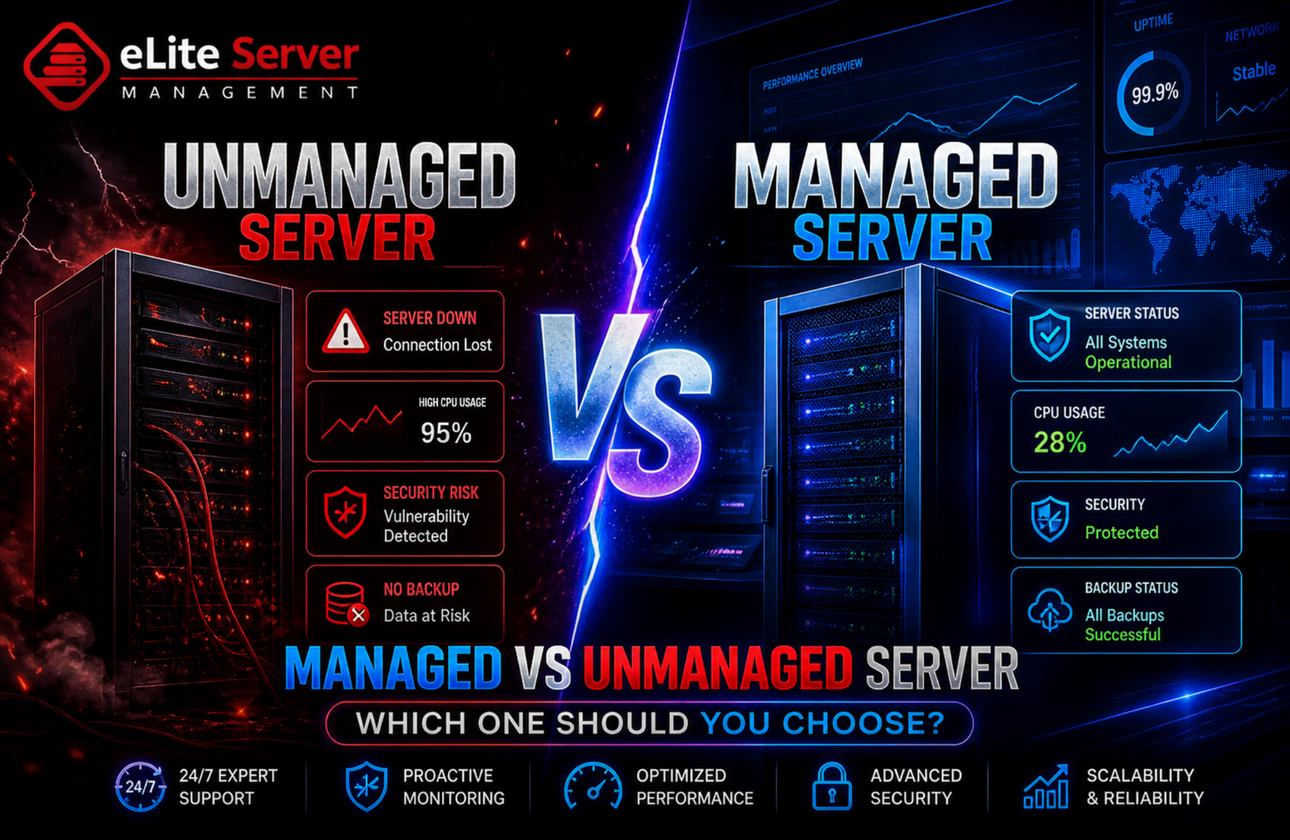
Choosing between a managed and unmanaged server isn’t just a technical decision—it directly impacts your uptime, security posture, operational costs, and long-term scalability.
Many businesses make this decision based purely on pricing. That’s a mistake.
The real question is:
Do you want to manage servers—or grow your business?
Let’s break this down with real-world scenarios so you can make a confident, practical decision.
Understanding the Core Difference
What is a Managed Server?
A managed server means your infrastructure is handled by experts.
This typically includes:
- Server setup and configuration
- OS updates and patching
- Security hardening
- 24/7 monitoring
- Performance optimization
- Troubleshooting and issue resolution
Instead of reacting to problems, managed environments are proactively maintained.
👉 Explore professional support:
https://eliteservermanagement.com/managed-server-services.php
What is an Unmanaged Server?
An unmanaged server gives you full control—but also full responsibility.
You are responsible for:
- Installation and configuration
- Security implementation
- Monitoring and alerts
- Backups
- Performance tuning
- Fixing issues during downtime
This model assumes you have strong in-house Linux server administration expertise.
The Real Cost Difference (Beyond Pricing)
At first glance:
- Unmanaged server = cheaper
- Managed server = higher cost
But that’s only surface-level.
Hidden Costs of Unmanaged Servers:
- Downtime losses
- Developer time spent on server issues
- Security risks and breaches
- Emergency fixes
- Performance-related revenue loss
Value of Managed Servers:
- Predictable performance
- Reduced downtime
- Faster issue resolution
- Better scalability
- Focus on core business
👉 In most cases, managed servers pay for themselves.
Real-World Scenario: Where Businesses Go Wrong
A SaaS company chose unmanaged infrastructure to reduce monthly costs.
What happened:
- No proper server monitoring
- CPU spikes went unnoticed
- Application crashed during peak hours
- Lost paying customers
After moving to a managed environment:
- Monitoring alerts prevented failures
- Downtime reduced drastically
- Performance stabilized
- Team focused back on the product
👉 Monitoring plays a key role:
https://eliteservermanagement.com/cpanel-server-monitoring.php
When Should You Choose a Managed Server?
✔ You Don’t Have an In-House DevOps Team
Most businesses underestimate how much expertise server management requires.
Managed services eliminate that dependency.
✔ Your Application is Business-Critical
If downtime directly impacts revenue:
- eCommerce stores
- SaaS platforms
- Client portals
Then, managed infrastructure is the safer option.
✔ You Need Strong Security
Security is not “set once and forget.”
Managed environments include:
- Continuous updates
- Firewall configuration
- Malware protection
- Proactive monitoring
👉 Strengthen your infrastructure:
https://eliteservermanagement.com/server-security-services.php
✔ You Want Predictable Performance
Performance issues often come from:
- Misconfiguration
- Resource mismanagement
- Lack of monitoring
Managed servers ensure optimization is continuous—not reactive.
✔ You’re Planning to Scale
As your traffic grows:
- Resource demand increases
- Complexity increases
Managed infrastructure ensures smooth scaling without chaos.
When Should You Choose an Unmanaged Server?
There are valid use cases.
✔ You Have an Experienced Sysadmin Team
If your team can handle:
- Linux administration
- Security
- Monitoring
- Optimization
Then, the unmanaged can work.
✔ You Need Full Control
Some environments require:
- Custom configurations
- Experimental setups
- Specialized applications
Unmanaged servers provide full flexibility.
✔ You’re Running Non-Critical Workloads
For:
- Testing environments
- Internal tools
- Development servers
Unmanaged is acceptable.
Managed vs Unmanaged: Side-by-Side Comparison
| Feature | Managed Server | Unmanaged Server |
|---|---|---|
| Setup | Done for you | Manual |
| Monitoring | 24/7 proactive | Self-managed |
| Security | Continuous | Manual |
| Support | Expert team | None |
| Downtime Risk | Low | Higher |
| Scalability | Guided | Self-managed |
The Biggest Mistake Businesses Make
They treat server management as a cost center, not a growth enabler.
This leads to:
- Poor performance
- Security vulnerabilities
- Lost revenue opportunities
The reality:
👉 Infrastructure is the foundation of your business operations.
The Role of Server Management Services
Professional server management bridges the gap between infrastructure and business performance.
👉 https://eliteservermanagement.com/managed-server-services.php
What you get:
- 24/7 monitoring
- Security hardening
- Performance tuning
- Backup management
- Issue resolution
Don’t Ignore Backup & Recovery
Even with strong infrastructure, failures can happen.
A proper backup strategy ensures:
- Data protection
- Fast recovery
- Business continuity
👉 https://eliteservermanagement.com/backup-services.php
Decision Framework (Quick Answer)
If you're unsure, use this:
| Situation | Recommendation |
|---|---|
| No technical team | Managed |
| Revenue-critical app | Managed |
| High traffic | Managed |
| Experimental/testing | Unmanaged |
| Skilled sysadmin team | Unmanaged |
The Bottom Line
Managed vs unmanaged is not about control vs cost.
It’s about:
- Reliability
- Security
- Scalability
- Business focus
If your infrastructure is critical to your operations, the safer and smarter choice is managed.
Focus on Growth — Not Server Issues
If you’re spending time fixing server problems instead of growing your business, it’s time to rethink your infrastructure.
✔ 24/7 expert support
✔ Proactive monitoring
✔ Performance optimization
✔ Security-first approach
👉 Explore managed solutions:
https://eliteservermanagement.com/managed-server-services.php